How to Build an Outcomes-Based Patient Support Program: 6 Takeaways from Patient Pathways 2026

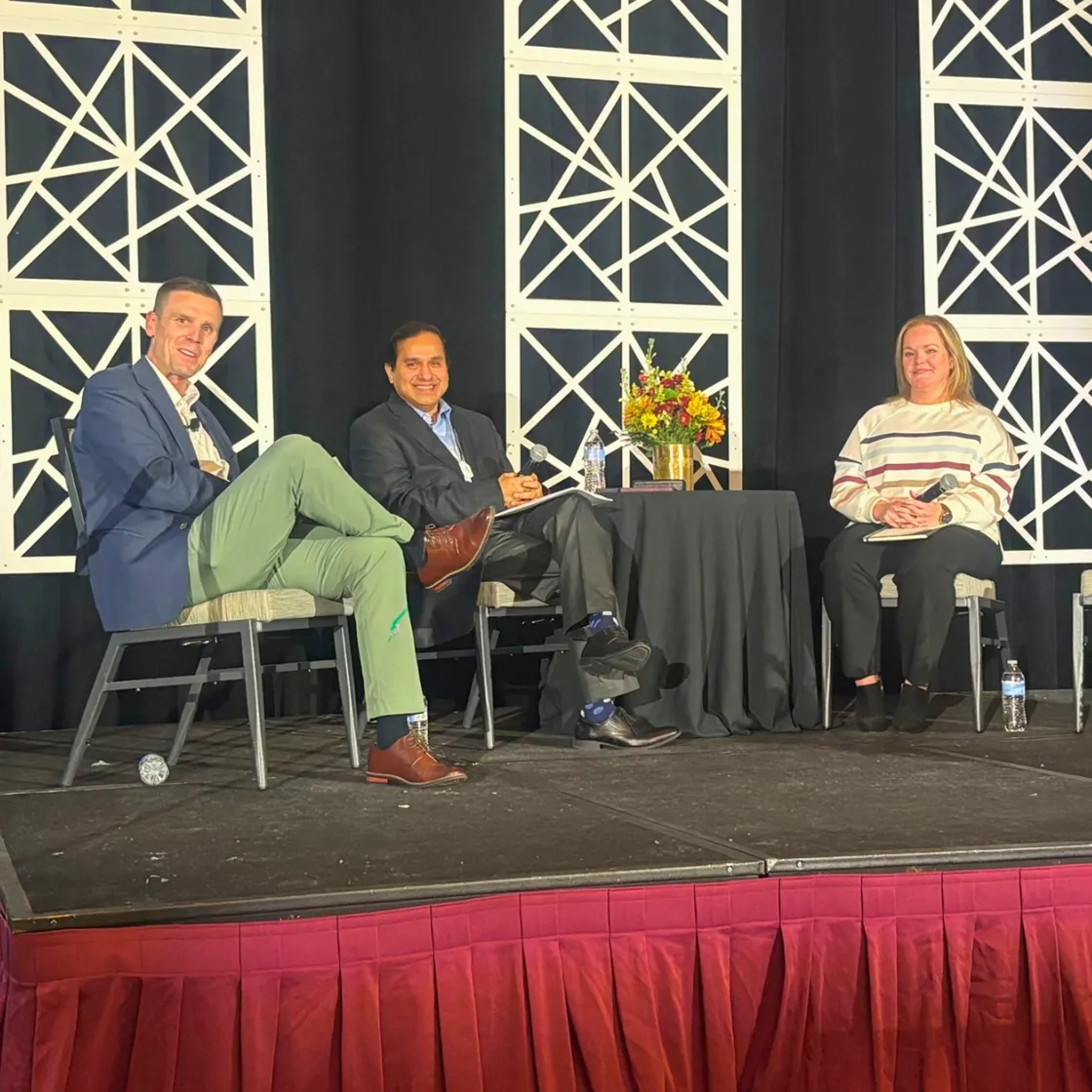
“You really cannot chart a patient journey without knowing the destination.”
That’s how Ian Ocilka, Market Strategy, Patient Services at Courier Health, began his panel discussion on November 19, 2026 at Informa’s Patient Pathways conference in Philadelphia. He was joined by two patient services leaders: Suresh Balachandran, Associate Director of Market Access, Patient Services, and Data Strategy at AbbVie, and Gretchen Williams, Director of Cell Therapy Patient Access Support Services at Bristol Myers Squibb (BMS).
The session, “From Intake to Impact,” was centered around one question: with more tools, data, and ambition than ever before, how do patient support programs ensure they’re driving measurable outcomes for patients? This blog recaps the conversation and provides six takeaways patient services organizations can apply.
What is an outcomes-based patient support program?
An outcomes-based patient support program starts with the result patients need, such as more new starts, faster time to therapy, longer persistence, or a better support experience, and then works backward to design the services, people, processes, and technology that deliver it. To see why that shift matters, start with what a patient support program does.
Almost every specialty therapy today requires wraparound support services that helps patients start and stay on therapy. A prescription is only the first step. Between that and treatment initiation comes benefits verification, prior authorizations, appeals, copay assistance, free drug programs, specialty pharmacy coordination, and, for many therapies, injection training or infusion scheduling. (And after the first dose comes the long work of adherence: refill reminders, nurse education, side-effect management, and a steady point of contact.)
Patient support programs are usually run through some mix of in-house teams, hub service providers, field reimbursement managers, case managers, and nurse educators. They answer to commercial, but they serve the patient. When they work, time to therapy shrinks, patients stay on treatment longer, and providers trust that their patients won't get lost in the system. The panel discussion highlighted the importance of keeping patients at the center of the support experience and regularly revisiting program ‘outcomes’ throughout the year, not just during a planning period, so that the program continues to improve over time.
Below we’ll dive into the six takeaways from the panel, each with steps your team can put into practice.
Outcomes aren’t SLAs
Hitting a turnaround time is significant, but it isn’t the desired end result. A service-level agreement (SLA) measures whether a task was completed on time, but an outcome measures what really changed for the patient.
Ian highlighted it as the difference between responsibility and accountability:
“Responsibility is a task-oriented approach. Accountability is an outcomes-based approach.”
SLAs help support outcomes, but too many programs treat them as the finish line.
Gretchen and Suresh described the outcomes their teams focus on, including new patient starts (including by line of therapy), persistence at three, six, and nine months, time to therapy, and how supported patients and caregivers feel.
In practice, this looks like:
- Translating each brand's priority into a patient outcome before you set up SLAs. This is how Suresh’s team at AbbVie builds its goals.
- Keeping your SLAs but treating them as inputs. For each one, name the outcome it moves.
- Giving persistence the same weight as new starts. Keeping patients on therapy matters as much as getting them started.
When the timeline is out of your hands, measure what you can control
Every program has aspects outside its control, whether that’s payer approvals, manufacturing, or a patient’s health history. Define outcomes around the experience you can shape, not the timelines or factors you can’t.
Gretchen works on CAR T therapies, which are personalized cancer treatments made from a patient's own immune cells. Each dose is built for one patient, which means BMS can't speed up manufacturing. Instead, Gretchen's team focuses on and measures what they can shape: "how supported the patient and caregiver feel during that wait time."
What does this mean for you?
- Map the end-to-end steps in your patient journey. For each step, ask yourself what patients and caregivers need (or want) while they wait.
- Track an experience measure, like CSAT or caregiver feedback, alongside core operational metrics.
- Plan proactive updates for long waits, so patients never have to wonder what’s happening or wait on hold for an answer.
Add technology only where it solves a real problem
Technology for technology’s sake adds cost without improving the patient experience. BMS’s CAR T patient access support team, named Courier Health’s 2026 Patient Innovators of the Year, screens every new tool with two questions: First, is this a real, recurring issue we hear from patients and caregivers? And second, does this technology solve it better than a person could?
That filter led to their mobile companion app. Patients used to dig through email for their travel itinerary at hotel check-in. Now patients, caregivers, and family members see all travel, lodging, and meal details in one place. One patient’s son used it to send dinner to his parents and their caregiver from another state. And when a hotel loses a reservation, patients still reach a person for assistance, not a chatbot.
Before you evaluate a tool:
- Document the pain point first: what's going wrong for patients or caregivers, how often it happens, and where it surfaced (e.g., patient calls or CSAT surveys). If you can't point to a recurring issue, the tool isn't solving a real problem yet.
- Decide up front which moments always need a human, like urgent travel or access issues.
- Look for ways to support the wider caregiver circle, not just the patient.
Start with a question, not a dashboard
More data doesn’t mean more insight. Suresh estimated that about half of the weekly dashboards and scorecards in the industry go unread. Data creates value when it answers a specific question.
His example: which patients have stalled, often between prior authorization approval and first fill, and are at risk of abandoning therapy? Once a patient abandons, the process often starts over, or the patient is lost entirely.
Put it into practice:
- Audit your existing reports and retire the ones nobody acts on.
- Flag stalled patients at every handoff, especially between approval and first fill.
- Get your hub, specialty pharmacy, and internal teams working from one source of truth, so everyone reports the same numbers for time to fill, abandonment, and fill rate.
Use AI to help your team be more present
The fastest AI wins aren’t patient-facing. They take administrative work off your team so they can focus on patients and caregivers.
Gretchen shared two examples of how her team is using AI today to unlock value. The first is an AI agent that answers questions from their standard operating procedures (SOPs). Users can ask a question and the answer pops up, instead of digging through the more than 20 SOPs it takes to run the program. The second is AI-drafted summaries of welcome calls, which can run 30 minutes to an hour. Users review each summary but no longer have to remember everything from the call, so they can focus on what the patient and caregiver are saying.
As Ian put it, there’s AI for execution and AI for efficiency. Many teams have grand visions of AI acting as a silver bullet, but the bigger impact often comes from automating high-volume, manual tasks that help people be present.
Put it into practice:
- List the repeatable, high-volume tasks required before and after patient or provider conversations.
- Keep a human in the loop on anything that becomes part of the patient record.
- Measure AI by its impact on patient outcomes, not by adoption.
Treat outcomes as a continuous loop, not an annual scorecard
Too many programs set target outcomes at the start of the year, only review them at year-end, and then start the process all over again. The strongest programs review outcomes throughout the year and use findings to continuously raise the bar. By focusing on a few priority outcomes and regularly measuring them, they can decide how their services drive those outcomes forward.
Put it into practice:
- Pick three (four at most) focus areas for the year. BMS identified key friction points and focused its energy there, which is how it arrived at the mobile companion app described above.
- Review outcomes at least quarterly: what moved, what didn’t, and why.
- Leave room for change. Policy shifts and market events can move targets mid-year, so your goals should be able to move with them.
Why this matters
Gretchen closed the panel with the one thing she’d keep going forward: a best-in-class patient support team that knows every small thing they do matters.
“A lot of patients in our CSAT surveys come back and say, ‘If I had not had the patient support program, I would not have been able to receive the medication.’ Every single thing that they do matters.”
Behind every metric is a patient trying to start therapy and a caregiver trying to help. Programs that define outcomes in those terms, and keep improving against them, are moving the needle.
Curious how other patient services teams are putting outcomes first? See how Courier Health’s Patient Services solution helps teams connect every step of the patient journey.