What Leaders Want Fixed in the Specialty Patient Journey
4 Insights from the 2026 Patient Innovators Summit


From attendee responses, four themes emerged:
- Bad data enters at intake
- Teams can’t see where patients are
- AI acts too late to prevent issues
- Patients still need people
Here’s what they told us, in their own words.
1. Bad patient data starts at intake and enrollment
Data quality was the most common pain point. Most responses traced poor data back to intake and enrollment.
For example, for "What frustrates my team most", one attendee shared:
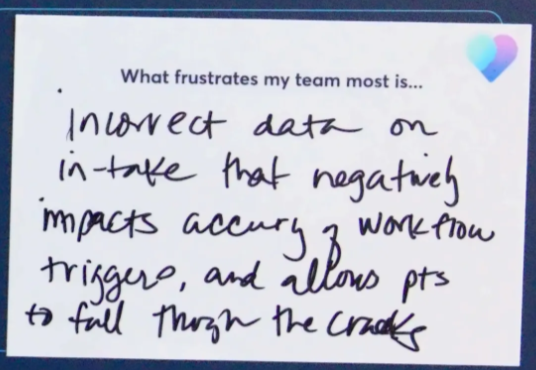
"Incorrect data on intake that negatively impacts accuracy of workflow triggers, and allows patients to fall through the cracks"
Others named "data integrations and clean up," "data delays that impact customer appointments," and "universal consent management across hub, SP, aggregators for sharing patient data."
These problems compound. What comes back from hubs and specialty pharmacies (SPs) is often incomplete, inconsistent, or outdated. Mistakes made at intake rarely stay there. A wrong insurance ID or a missed field shows up later as a benefits verification (BV) failure or a prior authorization (PA) denial. Either one can delay a patient’s start on therapy.
Market research tells a similar story. In Courier Health's 2026 State of Patient-Centricity in Biopharma report, which surveyed 162 biopharma leaders across 87 companies, 58% are unable to access, connect, analyze, and act upon their data. Only 9% have reached data maturity levels sufficient to power AI use cases.
2. Patient services and FRM teams can't see where patients are in the journey
The next most common theme was a visibility gap, a symptom of disconnected patient journeys. Teams know a patient is somewhere in the process, but they don't know where, or why the patient stopped.
"Trying to understand where patients are in intake process"
"Scrolling through notes to figure out what to do next"
"Lack of visibility into patient journey / not understanding abandonment reason"
It's a common gap: 43% of business leaders cite lack of patient/provider visibility and actionable insights as their top challenge.
Part of the problem is that the specialty patient journey isn't a straight line. It loops back and jumps forward depending on what happens at each step. A denied PA sends a patient into appeals. A failed appeal sends them toward a patient assistance program. Sales-centric tools built for linear journeys lose the thread. Teams need one view of every patient from intake through adherence: where they are now, and how they got there. (For a primer, see our guide to patient journey mapping.)
Physicians and their staff spend nearly two full business days, or about 13 hours, each week completing PAs (American Medical Association). Disconnected systems on the manufacturer side only add to that burden. Some attendees described PA work, including "PAs in multiple tools that hit duplicate edits or are not visible to the HCP or FRM." When the same PA lives in more than one system, it leads to duplicate submissions and conflicting records. Without a single source of truth, healthcare providers (HCPs) and field reimbursement managers (FRMs) fly blind, and patients get stuck. For more on this, see how to speed up prior authorization for medication.
Diana Villanova put it this way in the 2026 State of Patient-Centricity in Biopharma report:
"The more visibility you have into the patient journey, the more you're able to understand where your patients are getting stuck to intervene more strategically and minimize any road bumps."
3. Teams want AI to prevent issues in the first place
Several attendees asked for AI that gets ahead of problems.
"AI to intake enrollment & organize into patient file then do BI/BV"
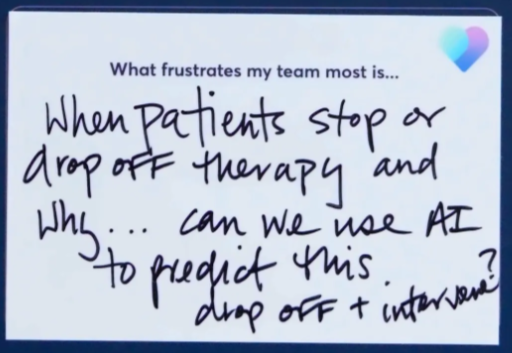
"When patients stop or drop off therapy and why... can we use AI to predict this? Drop off + intervene"
"How to include behavioral science in adherence risk assessment & outreach"
The appetite is there.
In our 2026 State of Patient-Centricity in Biopharma report, roughly 83% of biopharma respondents use AI in some capacity, up from 46.6% the year before. But most of that use is still basic. Of respondents using AI, 38% use it to automate routine tasks. Only 3% use agentic AI to execute complex actions independently.
AI that reads enrollment forms and creates patient records is already within reach. Agents designed specifically for biopharma can increasingly take on high volume work like AI intake processing, with people as the final check.
Predicting drop off is tricky without clean data and a clear view of where each patient is. AI layered on top of fragmented data has nothing reliable to work from. That’s why effective patient adherence solutions begin with connected data. With that foundation, AI can do more than automate tasks: it can flag the patients most at risk of dropping off, so teams can step in earlier.
4. Human work is still essential to patient access
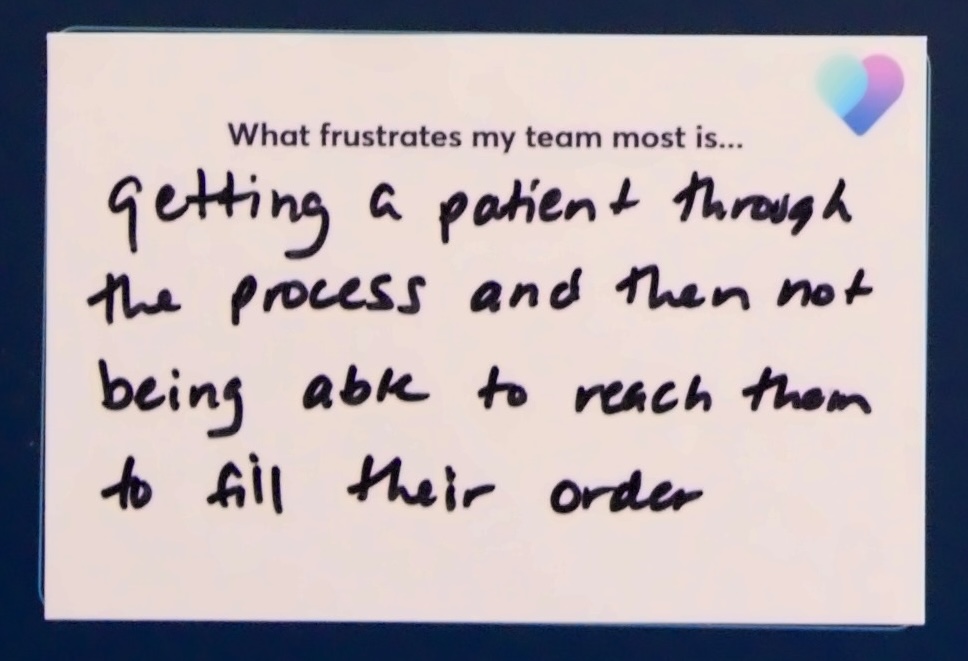
Many moments along the specialty patient journey need a person, like talking a patient through a tough decision or finding a creative way around an access barrier. Technology’s job is to help teams reach those patients. Attendees said that’s harder than it should be: “Trying to get offices to answer their calls,” "keeping track of each patient’s outreach preferences", and the below were all answers to "What frustrates my team most":
“Getting a patient through the process and then not being able to reach them to fill their order”
When software flags which patients need attention, suggests the best way to reach them, and lets teams act without switching tools, teams get time back for conversations that matter most. Chris Mancill, SVP and Head of US Market Access at AstraZeneca, described AI in the report as “an opportunity for us to be more human.”
How to improve the patient journey: start with the data foundation
Read together, the board tells one story. Bad data enters at intake. Teams lose sight of where patients are. Without a single view, they can't act to prevent problems, so they spend their days reacting to them.
Closing these gaps starts with the data foundation:
- Connect hub, SP, copay, and internal data into one source of truth for every patient journey.
- Turn that view into the next best action for each patient, so nothing falls through the cracks.
- Let AI take on the repetitive work, so teams can focus on the moments that need a person.
It's the approach we've built Courier Health around. On average, our clients connect 6+ data sources in one place. A good place to start: ask how long it takes your team to answer "where is this patient right now?"
Want to go deeper? Talk with one of our patient access experts.