Patient Experience Innovation in 2027
Executive Summary
Biopharma commercial teams head into 2027 facing two possible futures. The fork in the road is real, and waiting isn't an option. In one, the legacy system endures and every patient start gets harder. In the other, technology and ownership of the patient journey make access smoother and more predictable. The two can coexist; the question is which one manufacturers choose to invest in.
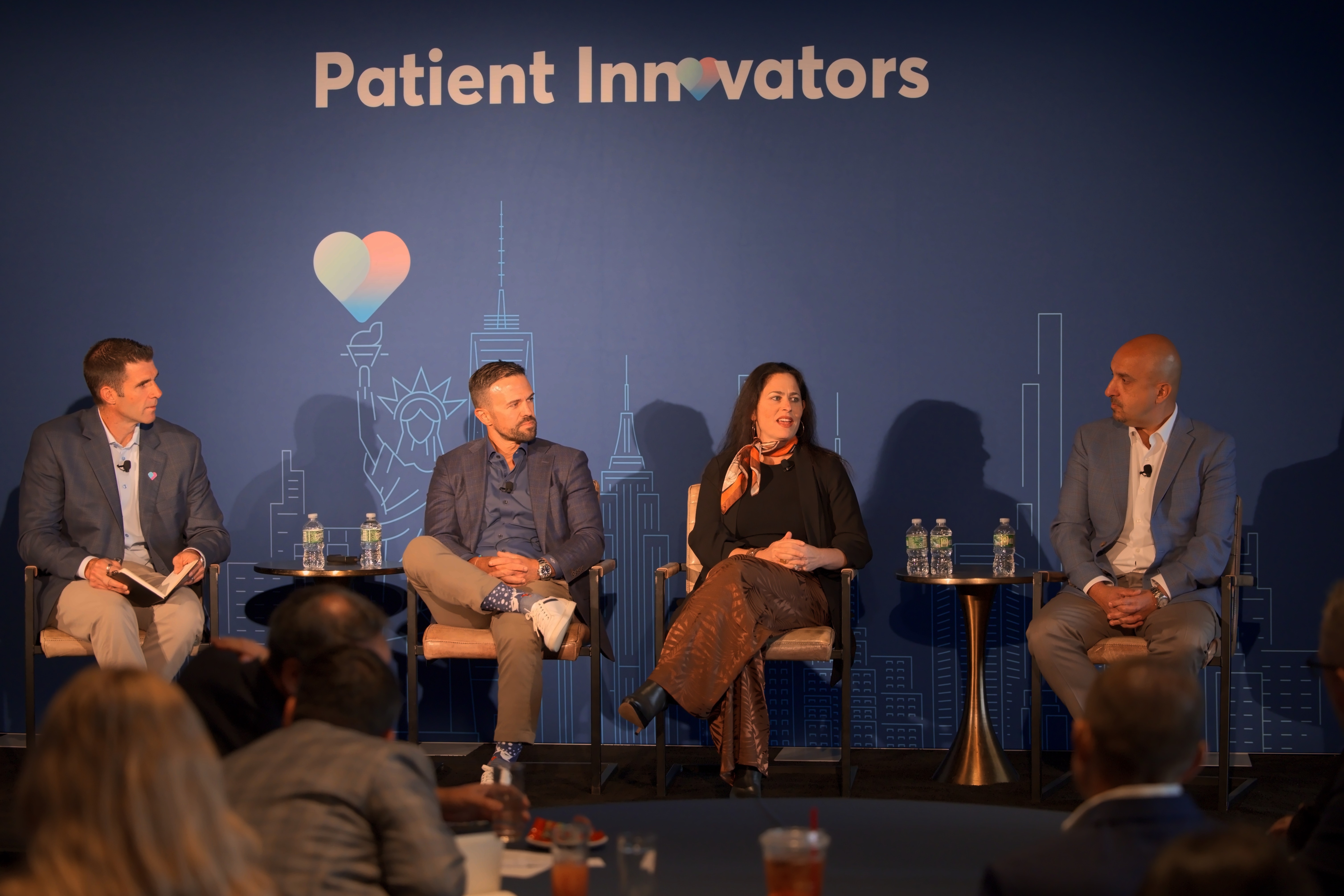
The 3rd annual Patient Innovators Summit brought together leaders across Market Access, Patient Services and Commercial IT & Analytics leaders for a day of in-person networking and learning. Together, the audience represented more than 100 diseases states and 35 million patients whose diseases or conditions were previously unmet. Through keynotes, candid fireside chats, and peer roundtables, the 2026 Patient Innovators Summit articulated what it takes to choose the better path for the biopharma patient experience. This recap dives into the market forces shaping this moment and what commercial innovators can do, across people, process, and technology.
The Fork in the Road
.png)
Two futures are taking shape for biopharma patient access and support, and they run side by side.
The industry keynote, UCB’s Head of US described the first future as “the same, but harder.” Incremental policy changes, administrative complexity, and market consolidation entrench the status quo. In the second future, technology and patient empowerment reshape access. AI reduces barriers for patients and providers, and real-world evidence flows into prior authorization in real-time, helping patients get the treatments they need sooner.
The same split shows up inside every Field Access and Patient Services team, in how the work gets done each day:
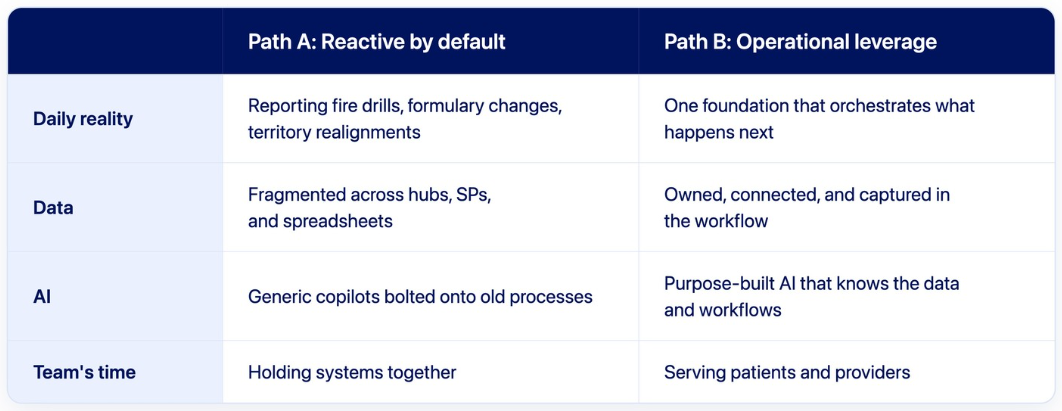
Path A feels like standing still, but it isn’t. As manufacturers take on more responsibility for the patient journey, growing data complexity and pressure to deliver measurable outcomes will expose gaps in infrastructure, and over time, the gap between these two paths will only widen.
Waiting isn't an option
The first future isn't going away, in part because the players who benefit will fight to keep it, even though they were designed decades ago when they couldn’t imagine this current inflection point. Meanwhile, the second future will grow in green shoots alongside it, meaning that navigating this moment will require what the industry operator called “strategic ambidexterity,” or navigating the current system while building for the future.
For manufacturers, this means focusing on the “no regrets” moves today: internal visibility and control, owned data, and people who dare to envision and champion a better future – no matter how challenging it may seem.
This requires strategic vision, leadership commitment, and investment to back it up. Otherwise, long-term priorities risk taking a back seat to day-to-day operational realities.
“Five years ago, owning data infrastructure was hard, painful, and more expensive. But today, it enables us to do things we couldn’t have done otherwise. These investments need to be an organizational priority and that starts at the top.”
Why Now
While none of these forces are new, they are compounding faster than ever before. As we’ve written about before, patient journeys are getting more complex as specialty medicines make up the majority of FDA approvals and global R&D pipelines.
- The system is spending more and delivering less. U.S. health spending hit $5.3 trillion in 2024, 18% of GDP (CMS). The average wait for a new-patient appointment is 31 days, up 48% since 2004 (AMN Healthcare).
- Access is getting harder. 70% of commercially insured patients have their first branded prescription denied, and initial rejections rose 13 percentage points from 2021 to 2025 (IQVIA). 95% of physicians say prior authorization delays necessary care (AMA).
- Policy headwinds are building. Medicaid cuts, 340B growth, PBM consolidation, and drug pricing reform all land on patient access teams.
- Teams are moving in-house. 91% of Field Access teams and 75% of Patient Services teams are now internal or hybrid.
- Major providers have exited the hub market. When a partner exits, the work moves to the manufacturer. Partners like copay and distribution still play a role, but what companies want from their hubs is changing, too. One large pharma leader put it simply: “Show me how you’re innovating and what I can learn from you.”
- The bar for proof is rising. Patient services are being pulled upstream into strategic brand and commercial launch planning, and executives want to know what the return is. Companies are shifting from activity metrics to activity & outcomes-based metrics that tell a more comprehensive value story.
It's one thing to generate demand. But if that prescription doesn't get pulled through, the patient doesn't get therapy and the company's not generating revenue."
For commercial leaders, the question isn't whether these forces will reach your team and program, the question is how you respond. Success will depend on three interconnected parts (and a familiar framework): people, process, and technology.
People
Commercial innovators who attended the 2026 Patient Innovators Summit kept discussing three investments they’re making.
1. Bring teams internal
Insourcing is less about cost than about control. As one panelist put it, outsourcing was always a “convenience play, a way to flex capacity up or down.” Insourced teams deliver better quality, clearer accountability, and a better experience for three primary reasons:
- Accountability gets visible. When the manufacturer designs the patient and provider experience, vendors can't hide breakdowns in the noise, and neither can the internal team.
- Turnover stops eroding the brand. High vendor turnover disrupts the experience, and patients and providers blame the brand, not the vendor.
- The talent pipeline gets stronger. Early-career, patient-centric hires learn reimbursement in-house and become tomorrow's field leaders and managers.
When teams own both the systems and the patient experience, they're directly responsible for the quality of the data they enter and rely on. Poor data quality creates problems they have to solve themselves, driving greater accountability.
“The behavior shift that I find very fascinating is that when you have your system in-house and your team in-house, it’s no longer garbage in, garbage out.”
2. Measure outcomes, not activity.
One leader summed up the mission in three words: "start and stay." Another team calls it "clear the way." Results-oriented leaders tie field incentives to conversion and adherence. Others replace activity targets with service levels (i.e., response-time targets), such as following up on a denied prior authorization or claim within 24 hours.
As part of ongoing team performance management, it’s important to balance proactive and urgent work. One medical-benefit team reserved roughly one-third of FRM capacity for urgent patient cases, while another re-anchored on the outcomes that matter most for their disease state and product type. For one ultra-rare team, that means delaying patient enrollment until a committed site of care and ancillary services are in place, trading a slower start for lifetime persistence.
3. Turn insights into a story
Field Access and Patient Services teams have a bigger seat at the executive table, but that seat comes with a harder question: what are we getting for this investment? Successful leaders pair a number with a story. Reframe the metrics.
Executives tend to see the world through a sales model, so it’s incumbent on leaders to reframe the metrics. One Field Reimbursement leader showed that his team engaged customers roughly 10 times as often as a typical sales reach-and-frequency model, helping to change the conversation.
Another leader printed the patient treatment journey on a 16-foot banner and hung it in the boardroom. Every swim lane and handoff showed why the team needed the size it was asking for.
Another attendee created a one-slide timeline of a single patient journey – the initial PA, the denial reason, the call to the parent, the approved appeal – to make a denial rate real and help justify why it was being prioritized.
Process
When it comes to process, Summit attendees discussed two things: the flexibility and creativity that AI affords to redesign the workflow, and the ongoing change management required to drive buy-in and adoption.
Workflow innovation
The rising trend of insourcing and introduction of AI have the opportunity to totally rewire how biopharma teams work. Commercial leaders understand the promise, but are still struggling to make it a reality.
For applications of AI, one leader noted a critical starting point is asking what should AI do, rather than what can AI do. For most Access & Reimbursement and Patient Services roles, the answer is not to replace the person but to remove the manual, high-volume work so the person can focus on the moments that matter. Patient and provider interactions that require empathy, creative problem-solving, and judgment.
You can’t replace the person with AI, and you can’t just relocate the workflows. As more of the patient journey moves internal, the path of least resistance may be copying the previous vendor model – the same intake steps, same handoffs, same data fields and reports – but that also copies the vendor’s constraints and shortcomings.
Innovators are using the moment to recalibrate, strip their workflows to the studs, use the patient journey to work back from first principles, and design a program that matches where they’re trying to go.
Change management
Especially with AI, leaders described change management as part of the work, not a phase that comes after. While it sounds basic, always start with the problem, not the tool, and define the right business problem first. Bring legal in early, run small pilots, review the results, and then decide.
- Bring users in early. Day-to-day users should help design the process. One team put field representatives in every technology meeting, even when it meant “too many cooks,” to avoid negative feedback and low adoption later.
- Have the discipline not to tinker. Owning the process creates the urge to change it after one week of data. Let the design work, coach your people, and change course when the data says so.
- Manage up, too. Executives hear an idea at a conference and want it next week. Especially with AI, there’s a lot of “silver bullet” promises where people are chasing shiny hype, not real results. Having a short-, medium- and long-term plan for where things are headed gives you an opportunity to respond “Yes, I’ve been thinking about that, and here’s when/where it fits in.”
Technology
95% of enterprise generative AI pilots show no measurable ROI. (MIT)
The AI hype cycle
The leaders pulling ahead aren't adopting the most AI, they’re staying agile while anchoring every investment to a specific friction point and building on data they own and trust. What do “non-hype” AI wins looks like in practice today?
- AI builds a knowledge base from what families report about local resources. Families tell case managers which county program or church has funding. That knowledge now lives in a system instead of walking out the door with one person.
- AI listens to every hub and copay call. Instead of sampling calls by hand, one leader gets a daily summary of every conversation. It flags coaching needs and early signs that something is changing in the market.
- AI builds an internal knowledge base to learn from. There were several examples of programs inputting knowledge – such as family experiences with local resources – into a single system. Patient support services is local, and that knowledge can now live in a single place instead of walking out the door with one person.
- AI summaries put everyone on the same page. AI can read and parse through data more efficiently and accurate than humans can. With the right first-party data inputs and program context, teams can access the same case, Provider, or Account summary, getting different team managers up to speed in minutes and ensuring nobody works from a different version of the truth.
In addition, some lines are remaining firm. Voice AI calling patients is the use case one large pharma leader plans to stay furthest from, longest.
Commercial IT leaders added their own perspective, too, admitting to a default to switch off new AI features until they can vet them and being particularly wary of building what they can't maintain. As one head of IT put it, "We're not a software development company."
“It’s not just about whether you can build something internally. It’s whether you have the right expertise, the right data foundation, and the ability to maintain it over time.”
Leading teams timebox pilots, often to about three months, with one measure of success and legal involved from the start. AI should be measured like any other operational investment: Does it reduce turnaround time, improve the customer experience, or help teams handle more volume without increasing costs? The goal isn't to be first or last to adopt AI, but to invest where it delivers measurable value.
AI for dual impact
At Courier Health, we see AI earning its place in patient access in two complementary ways: tools that make teams faster, and agents that take work off their plates.
- Tools for efficiency: you act, AI assists. Summaries of a patient, an account, or a payer. Plain-language questions answered from your own data in minutes, not weeks.
- Agents for productivity: AI acts, you approve. Processing enrollment documents. Chasing missing information before it becomes a denial. Assembling an appeal packet from the denial letter and PA requirements. With agents, teams shift from managing external human vendors to managing internal AI agents. They review, approve, and manage by exception instead of combing haystacks for needles.
None of this works without a foundation: a data model that understands patients, providers, benefits, and how they relate, plus orchestration on top. That is the infrastructure Courier Health builds.
As one industry executive described their deployment: "Is it a CRM? Is it an account management tool? No, it's an experience generator."
"We're all in this industry to help people. Technology should be an enabler and it's a force multiplier. It shouldn't be the thing that your teams spend their day jumping in and out of five different tools."
Building for 2027
Neither future arrives overnight, and nobody is going to rebuild everything at once. The leaders pulling ahead are making small, deliberate bets now: one role brought in-house, one data stream cleaned up, one activity metric swapped for an outcome, one AI use case aimed at a real point of friction.
Small changes made today are what shape the future, so rally your teams and your partners to shape the future before it’s too late.
Questions to bring back to your team
Here are a handful of “thought starter” questions covered at the 2026 Patient Innovators Summit that you can bring back to your teams as you prepare for 2027 and beyond:
- Which relationship would we least want a partner to own? What would it take for us to bring internal?
- Which activity metric could we replace, or supplement, with an outcome metric next quarter?
- What’s one new friction point where we can explore AI? What will success look like? How do we know if it’s valuable within the first 90 days?
- What patient and provider stories will we tell our executives this year?
None of this requires waiting for the system to change. The first future isn't going away overnight, but the second one is being built today by the teams willing to make small changes that compound tomorrow.