
Complete the form below to receive the white paper.

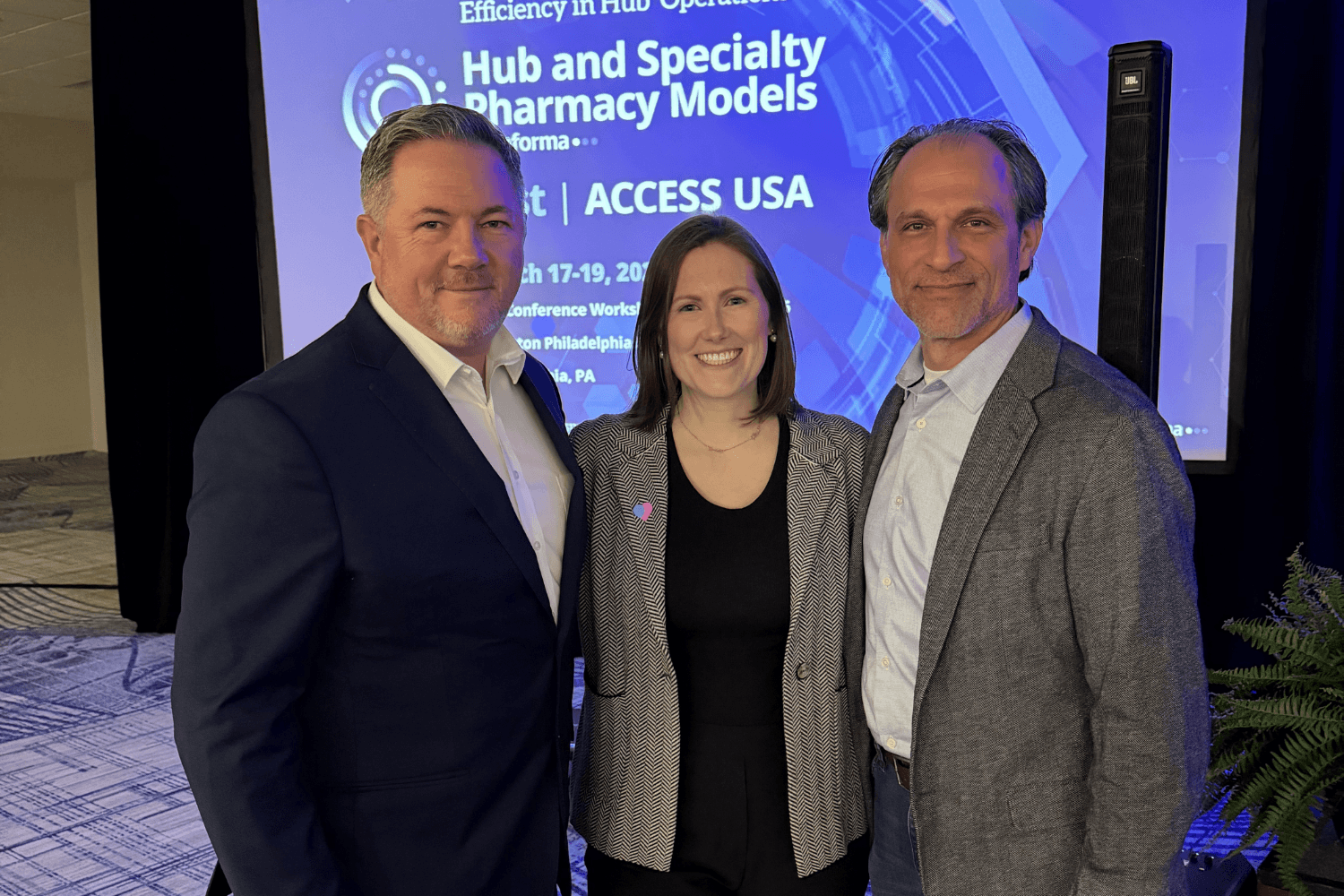
In March, our VP of Client Solutions, Rose Kozar, joined Jason Hampton, Executive Director of Patient Support Services and US Field Reimbursement at BioMarin, and Roy Hall, Head of Field Access at UCB, at Informa Access to discuss "Setting the Patient Experience for 2026".
The conversation was anchored in data from Courier Health's 2026 State of Patient-Centricity report, our annual survey of hundreds of biopharma commercial leaders. Inspired by the findings, the dynamic panel covered three of the most pressing challenges facing commercial teams today: data fragmentation, AI effectiveness, and what happens when the teams supporting patients are working from entirely different playbooks.
Whether you were in the room or not, read on (or watch!) for three key takeaways to raising the bar on the patient experience.
Roy Hall opened with framing that struck - and stuck with - everyone in the room: the industry does not have a data shortage problem, it has a usability problem.
"A lake is placid," Roy said. "An ocean can be turbulent and choppy - and the ability for different teams to take data from so many different streams and align it to a singular purpose is difficult."
Put another way, we're not operating in data lakes but rather vast data oceans.
That distinction matters because the knee-jerk reaction to data timeliness, quality, or overall ability to leverage to drive insights is often to add more of it. More feeds, more data fields, more tools, and more vendors. Our 2026 State of Patient-Centricity report found that nearly 60% of commercial leaders say their data is fragmented or not actionable, and it comes back to underlying systems.
The challenge is particularly acute as organizations grow and their data sources multiply. Specialty pharmacies, HUBs, sales team CRMs, payer feeds, field activity - each team is often drawing from (and adding to) a different pool. And when everyone is working from a different version of the truth, the downstream effects impact patients and providers.
What does this look like operationally? It looks like a sales rep, an FRM, a clinical coordinator, and a hub team all working toward the same patient with different data, different goals, and different responsibilities. It looks like an organization that tried to do too much with too much data and ended up fragmenting the patient journey in the process.
Understanding and navigating this data "ocean" starts with asking a different set of questions internally. Not "what data do we have?" but "what business question are we trying to answer, and what data do we actually need to answer it?" That is a harder conversation to have, but it is the right one to start with.
In addition, while 33% of respondents to this year's State of Patient-Centricity survey cited data being fragmented across systems as their top challenge to acting on information, almost the same percentage - 27% - flagged issues with overall data quality. These are upstream problems. Before data can be leveraged to power AI use cases, next best actions, or ongoing program optimization, the foundation needs to be solid.
We hear (and talk!) a lot about AI, and this session was no different. There is a temptation, especially given how fast AI has advanced in the last 18 months, to believe that better technology can compensate for messy infrastructure. It cannot.
"We can't be making business decisions on somewhat erroneous data," Jason said. "We don't understand the source, we don't know where the data came from - oh, but AI gave it to us, so let's use it. That's not the best approach."
Our 2026 State of Patient-Centricity report found that 83% of biopharma organizations are now using AI in some capacity, up from 46.6% last year - a dramatic jump. But we can't confuse AI access or experimentation with true adoption and value creation at scale. Only 12% of those organizations have approved tools, governance, and adoption across two or more teams, meaning the vast majority is informal and employee driven.
Both Jason and Roy shared concrete examples of what targeted AI experimentation and adoption looks like in practice:
"You've got to travel with it," Jason said about AI-generated insights. "You can't just send stuff out and let it live by itself. You've got to add the context. You've got to explain the data, explain where you got it, how it was done.
"This is an important caution for commercial teams feeling pressure to move fast on AI. The risk is not that AI will not produce an output but rather that the output will look credible enough to act on while being built on fragmented, low-confidence data.
The report finding that only 3% of respondents are using agentic AI (i.e., AI that executes complex actions independently) reflects a healthy skepticism across the industry. Both Roy and Jason expect that number to increase significantly in the next year as organizations get more comfortable with what works.
For teams trying to figure out where to start: pick one business question or problem to answer. Map the data you need to answer it, and then look at what AI can do to accelerate the analysis. That sequence matters.
"We end up presenting fragmented to the patient because we have fragmented data," Jason said. "Sales reps, FRMs, clinical coordinators, HUB teams - everybody's working through a different set of data, a different set of goals, a different set of responsibilities."
That signal is consistent with what patients, providers, and loved ones experience on the ground: handoffs that drop, calls that ask for information already provided, delays that no one on the internal team can explain because no one has the full picture.
This is where next best actions (NBA) came up as a through line throughout the Informa Access 2026 conference. Not as a buzzword, but as a practical mechanism for giving every person who touches the patient journey a shared sense of what should happen next. Jason put it simply: "If you tell the system that if you have issue X, the next best thing to do is Y, that's all it is. And it adds consistency."
That consistency is what bridges an oftentimes fragmented experience today. When a HUB team, an FRM, and a case manager are operating from a single system, analyzing the same data source, and driving toward the same next milestone or outcome, the patient experience does not feel like three separate companies are involved in their care but rather like one coordinated program.
Roy added helpful context from UCB's internal operating principles: focus on the signal versus noise. Not every case is a systemic problem and not every escalation represents a broken process. The goal is to identify when an issue is episodic versus emblematic. AI, when applied correctly, is a useful filter for that distinction, but the human element remains essential.
"AI will never be able to produce the qualitative data that people will produce for you," Roy said.
The practical implication for commercial teams is to look honestly at how many sources of truth your organization is working from. How many tools does your FRM team use on a given day? How many of those connect back to what patient services sees?
The work that determines your patient experience happens well before the patient ever shows up in your system, and it continues well past prescription. By the time someone is waiting on a status update or receiving a call asking for information they already provided, the real problem begins several steps back.
The organizations that close the gap and set a new standard for the patient experience will be the ones willing to ask harder internal questions before selecting their next tool or developing their patient program: What business question are we trying to answer? What data do we actually need? And are our teams aligned enough to act on the same answer?
The conversation at Informa Access was only a preview. The full data behind what biopharma commercial leaders are experiencing is in our 2026 State of Patient-Centricity report. Download it today.


True patient-centricity. Everyone says it, but few deliver. Upgrade your patient experience with Courier Health.
Contact Us


